I’m Christian and respect the order of creation as God intended it but I’m not gonna lie if I could take a massive vat of agar and grow an alive shopping mall made out of red blood and meat and feed it living human bodies to make it expand larger with more shops and amenities, Without hesitation, Without question I would do exactly that
I’m watching Pingu right now and wow how did I forget that Pingu once tried to recreate the Tower of Babel.
Would love to hear the Vatican’s opinions on this.
they are animals, and thus free of sin. In fact, doctrinally, animals give glory to God merely by existing so. Pingu’s fine
But by creating a tower tall enough to reach God’s kingdom, would they achieve sin?
“At one famous trial in Autun, France, in 1522, some rats were charged with feloniously eating and wantonly destroying the province’s barley crop and so were ordered to appear in court. “ if rats can commit crimes, penguins can sin
That’s French courts though. France is a perversion of every law, moral, or truth known to man or heaven.
new atheists deride religion as “primitive superstition” but when you hear their take on what religion is it’s clear they have the shallowest concept of it
Y’all are the ones with holy books about talking snakes and blood sacrifices, but go off I guess
see what i mean
I will start believing the day you introduce me personally to your god(s).
see what i mean
What exactly is there deeper to understand that y’all worship a genocidal maniac and that you only read one book???
see what i mean
Religion is useless. We will all die eventually and your phony gods cannot help you
see what i mean
Toward the end of Gröning’s stay at the Grande Chartreuse, the monks asked him (in notes, probably) what he had learned from them. The question came as a surprise to Gröning, who had “drifted away from speech by then” that he hadn’t worked out his ideas in words.
Eventually, he said, “I realized that what I had actually learned was that it is possible to live very much without fear, because this is what they do. They live without fear. I wanted the audience to be able to share this.”
Toward the end of Gröning’s stay at the Grande Chartreuse, the monks asked him (in notes, probably) what he had learned from them. The question came as a surprise to Gröning, who had “drifted away from speech by then” that he hadn’t worked out his ideas in words.
Eventually, he said, “I realized that what I had actually learned was that it is possible to live very much without fear, because this is what they do. They live without fear. I wanted the audience to be able to share this.”
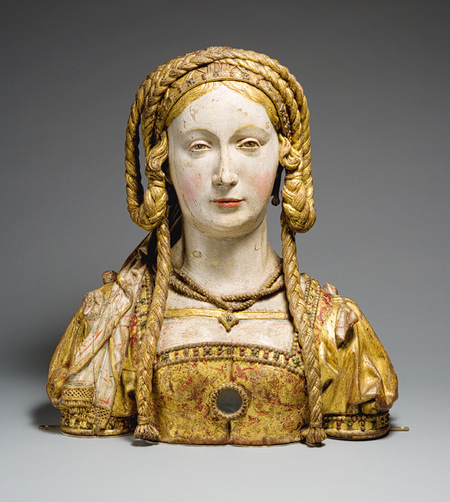
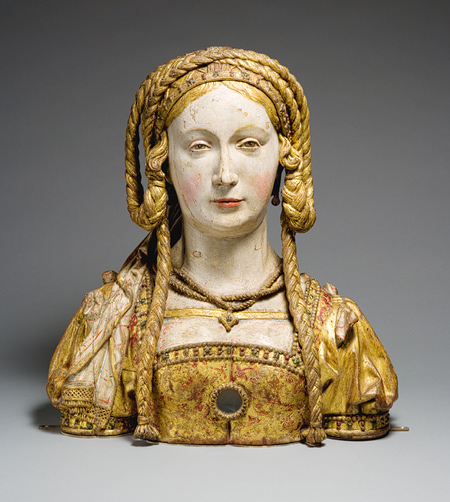
Reliquary Bust of Saint Balbina, ca. 1520–30 South Netherlandish (possibly made in Brussels, Belgium)
“All reliquaries derive their power from the relic they contain as well as from the beauty and intrinsic qualities of the vessel. Reliquaries in the form of busts became widespread during the High Middle Ages. This head (made of painted and gilded oak) contains the skull of Saint Balbina, an early virgin martyr of Rome. The label on the little door on top identifies the relic inside. She is richly dressed in a fashionable gown and with jewelry and an elaborate coiffure.” (metmuseum.org)
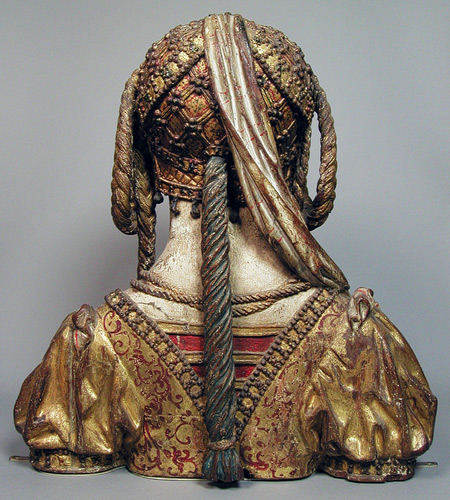
Reliquary Bust of Saint Balbina, ca. 1520–30 South Netherlandish (possibly made in Brussels, Belgium)
“All reliquaries derive their power from the relic they contain as well as from the beauty and intrinsic qualities of the vessel. Reliquaries in the form of busts became widespread during the High Middle Ages. This head (made of painted and gilded oak) contains the skull of Saint Balbina, an early virgin martyr of Rome. The label on the little door on top identifies the relic inside. She is richly dressed in a fashionable gown and with jewelry and an elaborate coiffure.” (metmuseum.org)
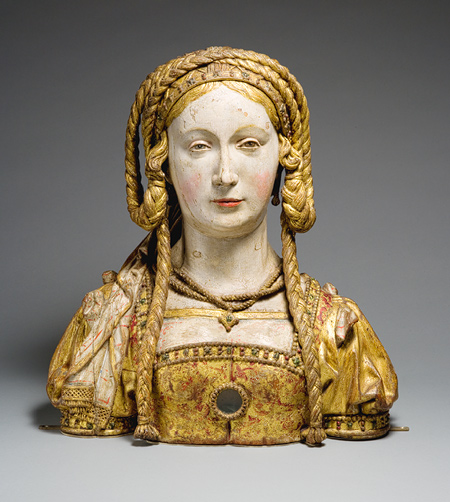
Reliquary Bust of Saint Balbina, ca. 1520–30 South Netherlandish (possibly made in Brussels, Belgium)
“All reliquaries derive their power from the relic they contain as well as from the beauty and intrinsic qualities of the vessel. Reliquaries in the form of busts became widespread during the High Middle Ages. This head (made of painted and gilded oak) contains the skull of Saint Balbina, an early virgin martyr of Rome. The label on the little door on top identifies the relic inside. She is richly dressed in a fashionable gown and with jewelry and an elaborate coiffure.” (metmuseum.org)
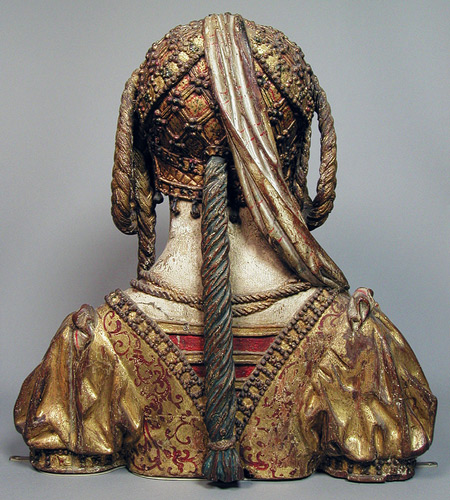
Reliquary Bust of Saint Balbina, ca. 1520–30 South Netherlandish (possibly made in Brussels, Belgium)
“All reliquaries derive their power from the relic they contain as well as from the beauty and intrinsic qualities of the vessel. Reliquaries in the form of busts became widespread during the High Middle Ages. This head (made of painted and gilded oak) contains the skull of Saint Balbina, an early virgin martyr of Rome. The label on the little door on top identifies the relic inside. She is richly dressed in a fashionable gown and with jewelry and an elaborate coiffure.” (metmuseum.org)