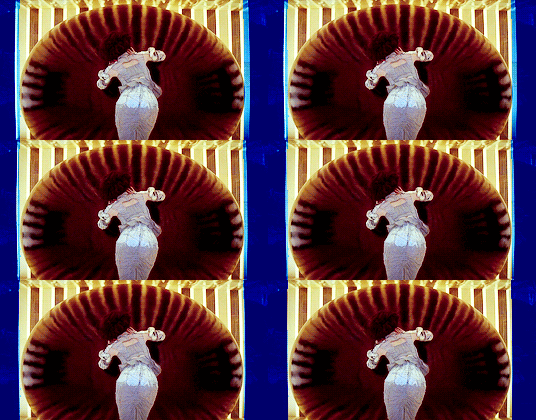
Seeing a lot of Goncharov content but only real 70s movie heads will know that Spanish director Pere Portabella was meant to be making a behind-the-scenes documentary of the film which turned into a whole other thing. It’s called GOMORRA CALLS.
Scorsese is in it and so are his parents, for some reason. At first you’re just like oh this is cute, they’re bringing food to the set, taking an interest in what’s going on. But it becomes this quite… Creepy reality-bending thing? His mother keeps cryptically referring to weird telephone calls they’ve been getting at home, and his dad keeps moving things on the set, you can only see what he’s doing if you spend a lot of time watching him at the edge of the frame while someone else is talking. And sometimes they’ll get to the set in the morning and find things left in the wrong place, there’s a weird smear on a camera lenses, one of the actors has lost half the pages from the copy of the script they’ve been learning from.
I think the idea was meant to be that they’re being hounded by the realfe mafia for making the movie. But it almost seems like they’re being haunted by the ghosts of mafia members at times. Like, Scorsese’s hotel room will be freezing cold, and he’s being sent anonymous messages at the front desk in a way that just doesn’t make sense. He says, “I’m not sure if someone is trying to stop this movie… Or if they just want to be part of it. If they want to look at a prop in the wrong place and just say, hey, that was me.”
At the time of its limited run in the US, Scorsese said he didn’t really know what Portabella was making, fueling theories that the film was true documentary and not fictionalised. But it’s listed as fiction on Portabella’s Wikipedia page now, and the prevaing theory is that it must be made up. It’s not been included on any of the Goncharov DVD or Blu-Ray packages but it was supposed to be a Criterion Channel exclusive last year… It never showed up, and there are rumours it’s to do with audio licensing issues. But there’s a VHS rip floating around out there if you know where to look.
I used to think it was silly that Haynes, in the 1984 scenes, outlined a vague conspiracy about bland corporate rock and its complicity with the security state. Now I’m not so sure—not when the much-heralded future of the entertainment industry is algorithmically generated home broadband sweeteners masquerading as art, and the act of consumption is beginning to resemble another British dystopia about aesthetic conformity, the one about being immobilized in a chair and subjected to an unrelenting torrent of brain-bleaching Content. Seen from the vantage of the endless 2020, Velvet Goldmine comes back around to universality. It inspires you to be not just a consumer, but an aesthete, curator, explorer, and invests those identities with life-or-death urgency.
I used to think it was silly that Haynes, in the 1984 scenes, outlined a vague conspiracy about bland corporate rock and its complicity with the security state. Now I’m not so sure—not when the much-heralded future of the entertainment industry is algorithmically generated home broadband sweeteners masquerading as art, and the act of consumption is beginning to resemble another British dystopia about aesthetic conformity, the one about being immobilized in a chair and subjected to an unrelenting torrent of brain-bleaching Content. Seen from the vantage of the endless 2020, Velvet Goldmine comes back around to universality. It inspires you to be not just a consumer, but an aesthete, curator, explorer, and invests those identities with life-or-death urgency.
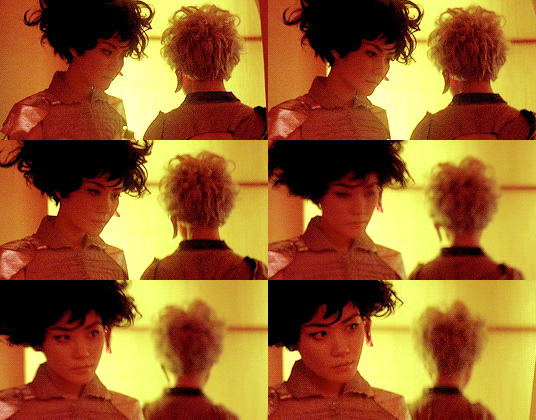
it’s no good meeting the right person too soon or too late
2046 (2004) dir. Wong Kar-wai
Toward the end of Gröning’s stay at the Grande Chartreuse, the monks asked him (in notes, probably) what he had learned from them. The question came as a surprise to Gröning, who had “drifted away from speech by then” that he hadn’t worked out his ideas in words.
Eventually, he said, “I realized that what I had actually learned was that it is possible to live very much without fear, because this is what they do. They live without fear. I wanted the audience to be able to share this.”