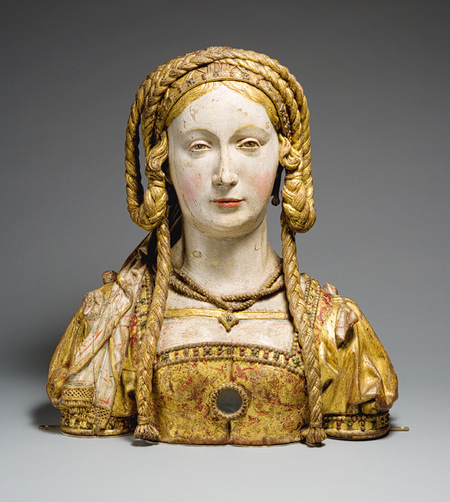
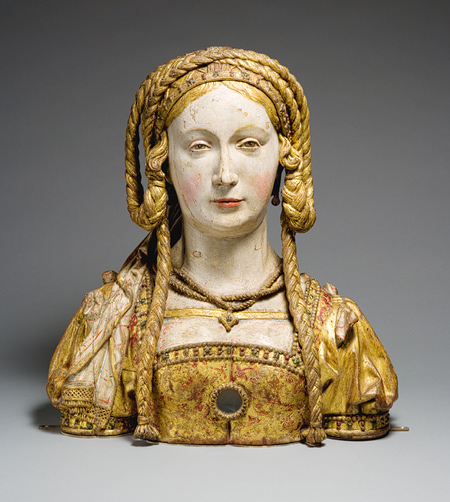
Reliquary Bust of Saint Balbina, ca. 1520–30 South Netherlandish (possibly made in Brussels, Belgium)
“All reliquaries derive their power from the relic they contain as well as from the beauty and intrinsic qualities of the vessel. Reliquaries in the form of busts became widespread during the High Middle Ages. This head (made of painted and gilded oak) contains the skull of Saint Balbina, an early virgin martyr of Rome. The label on the little door on top identifies the relic inside. She is richly dressed in a fashionable gown and with jewelry and an elaborate coiffure.” (metmuseum.org)
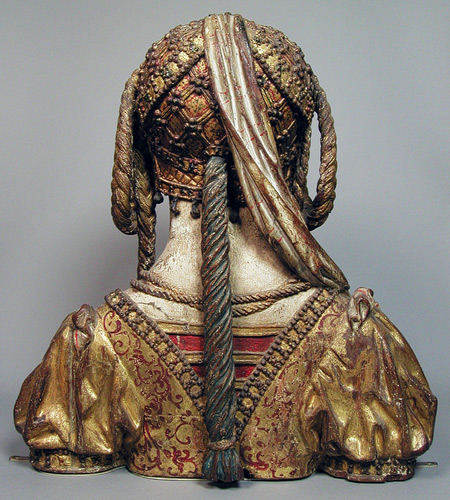
Reliquary Bust of Saint Balbina, ca. 1520–30 South Netherlandish (possibly made in Brussels, Belgium)
“All reliquaries derive their power from the relic they contain as well as from the beauty and intrinsic qualities of the vessel. Reliquaries in the form of busts became widespread during the High Middle Ages. This head (made of painted and gilded oak) contains the skull of Saint Balbina, an early virgin martyr of Rome. The label on the little door on top identifies the relic inside. She is richly dressed in a fashionable gown and with jewelry and an elaborate coiffure.” (metmuseum.org)
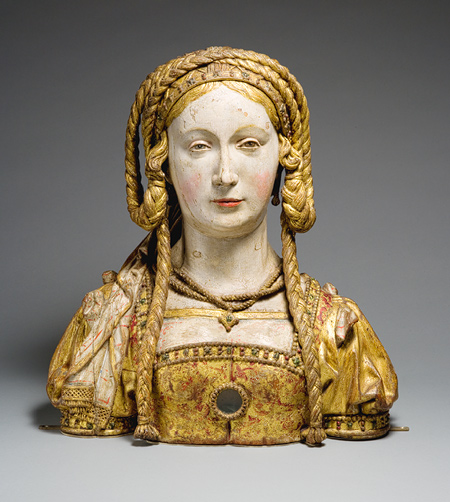
Reliquary Bust of Saint Balbina, ca. 1520–30 South Netherlandish (possibly made in Brussels, Belgium)
“All reliquaries derive their power from the relic they contain as well as from the beauty and intrinsic qualities of the vessel. Reliquaries in the form of busts became widespread during the High Middle Ages. This head (made of painted and gilded oak) contains the skull of Saint Balbina, an early virgin martyr of Rome. The label on the little door on top identifies the relic inside. She is richly dressed in a fashionable gown and with jewelry and an elaborate coiffure.” (metmuseum.org)
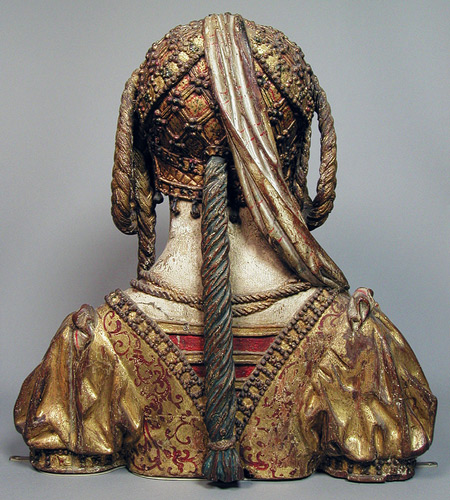
Reliquary Bust of Saint Balbina, ca. 1520–30 South Netherlandish (possibly made in Brussels, Belgium)
“All reliquaries derive their power from the relic they contain as well as from the beauty and intrinsic qualities of the vessel. Reliquaries in the form of busts became widespread during the High Middle Ages. This head (made of painted and gilded oak) contains the skull of Saint Balbina, an early virgin martyr of Rome. The label on the little door on top identifies the relic inside. She is richly dressed in a fashionable gown and with jewelry and an elaborate coiffure.” (metmuseum.org)
white dude in this horror movie : *translates old arabic text* *somehow it rhymes perfectly in english*
Now I really wanna see a horrible faltering translation from one of these movies, like “Whomsoever enters this room, they shall… well, this word is like… literally it means ‘unbecome,’ but it was used as a euphemism for death, pooping, and—wait, when was this carved? was it 15th century? Cuz it was a euphemism for sex too in the 15th century. This is either a cursed crypt, a bathroom, or a royal bedroom. Who wants to roll the dice?”
“You guys, I’ve gotta be honest, okay? This thing’s written in some kind of weird localized dialect, and I’ve only ever studied the standard form of the language. I mean, this part right here…I can’t even tell if it’s some kind of error, or an obscure slang phrase…whatever it is, I have no idea what the fuck it means.”
‘this is written in ancient sumerian. it’s about… uh… well that word is… uh. okay this is either a poem about farming, or straight-up a nasty sex guide. it might be both. i want a shower.’