hellotailor:

nubbsgalore:

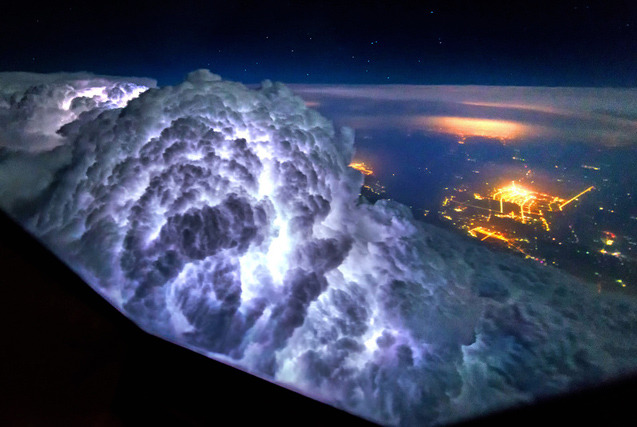
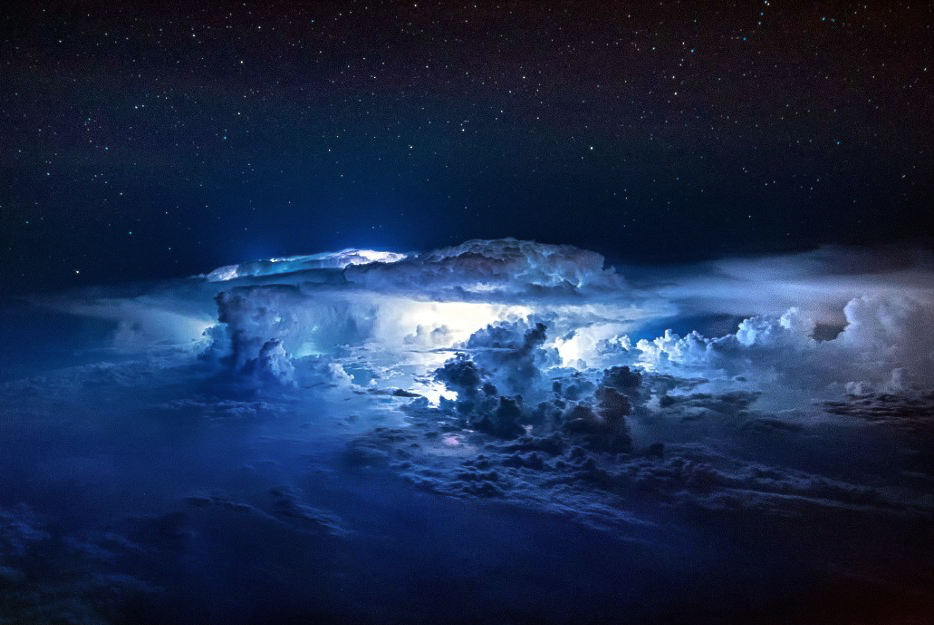
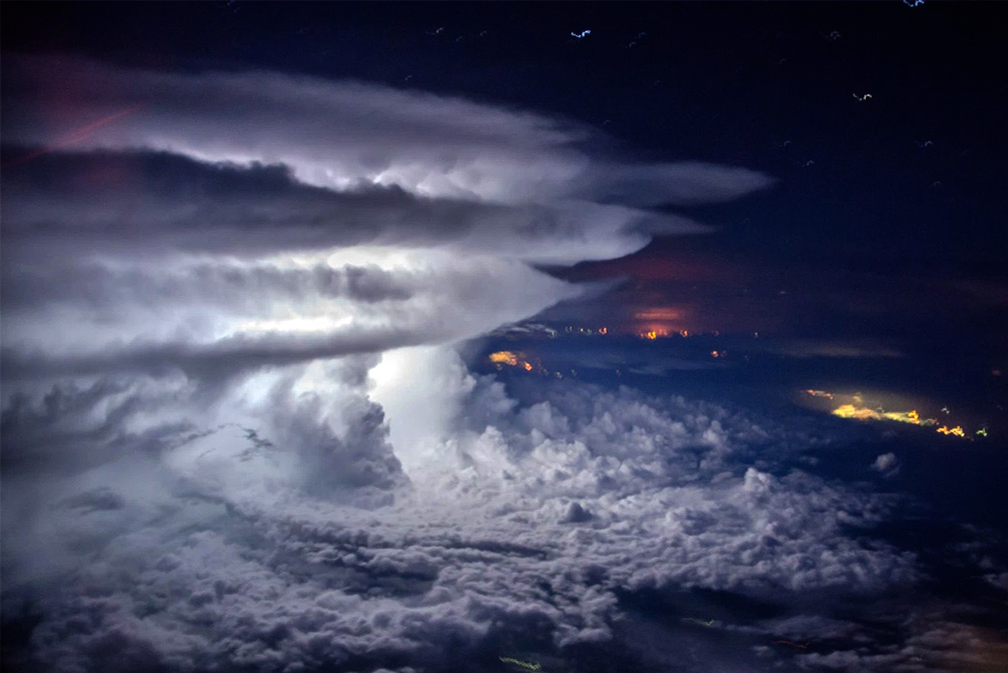
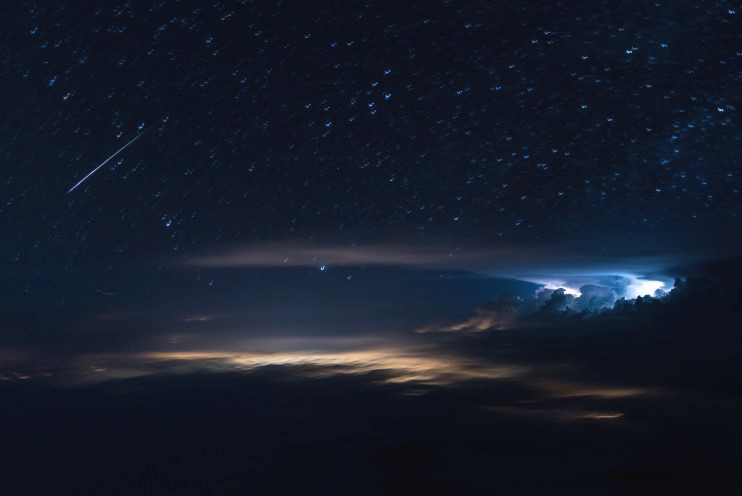
three separate off duty commercial aviators photographed cumulonimbus clouds illuminated by flashes of lightning from their planes.

otherwise known as thunderclouds, cumulonimbus are the only cloud type that can produce hail, thunder and lighting. the base of the cloud is often flat with a very dark wall like feature hanging underneath, and may only lie a few hundred feet above the earth’s surface.   

cumulonimbus clouds are created through convection, often growing from small cumulus clouds over a hot surface.they get increasingly big until they represent huge powerhouses, storing the same amount of energy as ten hiroshima sized atom bombs. 

although the storm looks formidable, today’s airliners have advanced equipment to circle around storms this big without entering any dangerous zones.

(photos xx

These photos kept reminding me of something, and then I realized what it was: 

“You can’t help but notice the sky in American Gods. Looming stormclouds and rainbow nebulae dominate the view during outdoor scenes, evoking a sense of religious wonder. The message is: humans are very small, and there’s a lot going beyond our understanding.”

American Gods, a spoiler-free review

It’s not exactly unusual for filmmakers to use beautiful shots of the sky, because, you know, it’s the damn sky. It’s everywhere. But American Gods incorporates a surprising amount of CGI sky in otherwise ~normal scenes, adding a sense of heightened reality. It’s reminiscent of the way old cathedrals were designed to inspire awe by being huge and cavernous and impressive. And IMO it shows a great understanding of Neil Gaiman’s approach to fantasy, which holds true across most of his work: set in the “real” world, with weird dark shit looming in the background.
hellotailor:

nubbsgalore:

three separate off duty commercial aviators photographed cumulonimbus clouds illuminated by flashes of lightning from their planes.

otherwise known as thunderclouds, cumulonimbus are the only cloud type that can produce hail, thunder and lighting. the base of the cloud is often flat with a very dark wall like feature hanging underneath, and may only lie a few hundred feet above the earth’s surface.   

cumulonimbus clouds are created through convection, often growing from small cumulus clouds over a hot surface.they get increasingly big until they represent huge powerhouses, storing the same amount of energy as ten hiroshima sized atom bombs. 

although the storm looks formidable, today’s airliners have advanced equipment to circle around storms this big without entering any dangerous zones.

(photos xx

These photos kept reminding me of something, and then I realized what it was: 

“You can’t help but notice the sky in American Gods. Looming stormclouds and rainbow nebulae dominate the view during outdoor scenes, evoking a sense of religious wonder. The message is: humans are very small, and there’s a lot going beyond our understanding.”

American Gods, a spoiler-free review

It’s not exactly unusual for filmmakers to use beautiful shots of the sky, because, you know, it’s the damn sky. It’s everywhere. But American Gods incorporates a surprising amount of CGI sky in otherwise ~normal scenes, adding a sense of heightened reality. It’s reminiscent of the way old cathedrals were designed to inspire awe by being huge and cavernous and impressive. And IMO it shows a great understanding of Neil Gaiman’s approach to fantasy, which holds true across most of his work: set in the “real” world, with weird dark shit looming in the background.

ucflibrary:

delawarelibrary:

teencenterspl:

sixpenceee:

Mike Hollingshead of Extreme Instability has released an amazing series of 17 HD looping storm gifs at an amazing 1920×1080 resolution. You can check out the full gallery here but be warned, some of the gifs may take a moment to load, with some as large as 20-30 MB.

This is so cool

This is awesome. And it reminds us of the Teens Weather Spotters program that’s happening during Teen Tech Week March 6 – 10!

That is awesome and terrifying at the same time. 

People can’t anticipate how much they’ll miss the natural world until they are deprived of it. I have read about submarine crewmen who haunt the sonar room, listening to whale songs and colonies of snapping shrimp. Submarine captains dispense “periscope liberty” – a chance to gaze at clouds and birds and coastlines – and remind themselves that the natural world still exists. I once met a man who told me that after landing in Christchurch, New Zealand, after a winter at the South Pole research station, he and his companions spent a couple of days just wandering around staring in awe at flowers and trees. At one point, one of them spotted a woman pushing a stroller. “A baby!” he shouted, and they all rushed across the street to see. The woman turned the stroller and ran. Nothing tops space as a barren, unnatural environment. Astronauts who had no prior interest in gardening spend hours tending experimental greenhouses. “They are our love,” said cosmonaut Vladislav Volkov of the tiny flax plants – with which they shared the confines of Salyut 1, the first Soviet space station. At least in orbit, you can look out the window and see the natural world below. On a Mars mission, once astronauts lose sight of Earth, they’ll be nothing to see outside the window. “You’ll be bathed in permanent sunlight, so you won’t eve see any stars,” astronaut Andy Thomas explained to me. “All you’ll see is black.”