panasonicyouth:

dedicated to like the five people I know who read china mieville books because i NEVER see posts about them on tumblr

also to my friends who have read the brilliance that is the miseducation of cameron post. why a book about a cynical and sassy 11-year old lesbian is not the biggest book on tumblr is a goddamn mystery to me

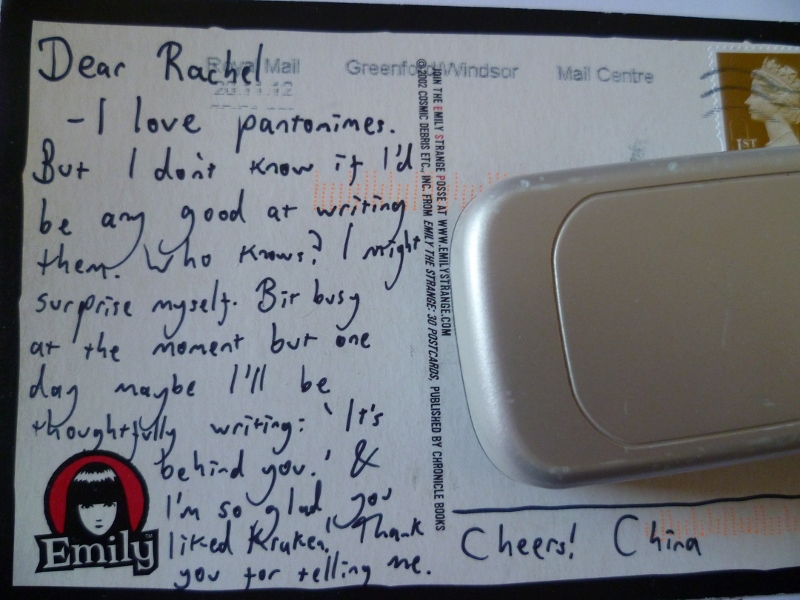
Last year I wrote to China Mieville about how I really enjoyed Kraken and asked if he’d ever consider writing a panto (‘cos he’d just started Dial H and I started wondering what other formats he might take on (that and I’d started considering an Avengers panto)).

This was his response:
image

Dear Rachel,

I love pantomimes. But I don’t know if I’d be any good at writing them. Who knows? I might surprise myself. Bit busy at the moment but one day maybe I’ll be thoughtfully writing: ‘It’s behind you.’ & I’m so glad you liked Kraken. Thank you for telling me.

Cheers!

China

Depends what you mean by “satisfy”. I’m tempted to say that part of the job a monster can do best is refuse to satisfy me, completely — which is good, because what I want for satisfaction is a kind of satiation, which usually translates into too much information, into overkill, into shining a light where a light has no business shining. In other words, the frustration that I feel at not understanding everything about a monster (indeed the weird, indeed anything fantastic) is both a sign that I am not fully satisfied and the only way of doing this with anything approaching success, I imagine. I want to know everything, but I don’t want that desire to be fulfilled. Unsatisfy me, frustrate me, I beg you, teratologists and others. The point is, as all my favourite writers and artists and musicians and whatever know, I cannot be trusted.

China Miéville in response to “If a monster believes in itself, can it remain inexplicable within the arc of a story and still satisfy you?”

China Miéville and Monsters: “Unsatisfy me, frustrate me, I beg you.” | Jeff VanderMeer | Weird Fiction Review

orbiculator:

The sea is full of saints. You know that? You know that: you’re a big boy.

The sea’s full of saints and it’s been full of saints for years. Since longer than anything. Saints were there before there were even gods. They were waiting for them, and they’re still there now.

Saints eat fish and shellfish. Some of them catch jellyfish and some of them eat rubbish. Some saints eat anything they can find. They hide under rocks; they turn themselves inside out; they spit up spirals. There’s nothing saints don’t do.

Make this shape with your hands. Like that. Move your fingers. There, you made a saint. Look out, here comes another one! Now they’re fighting! Yours won.

There aren’t any big corkscrew saints any more, but there are still ones like sacks and ones like coils, and ones like robes with flapping sleeves. What’s your favourite saint? I’ll tell you mine. But wait a minute, first, do you know what it is makes them all saints? They’re all a holy family, they’re all cousins. Of each other, and of … you know what else they’re cousins of?

That’s right. Of gods.

Alright now. Who was it made you? You know what to say.

Who made you?

The prologue of Kraken, by China Mieville.

Gamochonia, by Ernst Haeckel in Kunstformen der Natur.

From top left, clockwise:

Histioteuthis bonnellii

Chiroteuthis veranyi

Pinnoctopus cordiformis

Octopus vulgaris(ventral)

Octopus vulgaris (dorsal)

4 final Orpheuses

tentacular:

  1. Orpheus, shambling & drunk on shadows, sees sunlight & emerges into what he thinks is the world; into what with a blinking look around he decides with only a shade of uncertainty is not merely widening in the passage itself, a kind of rough natural vestibule, but must surely count as the outside. He starts to turn & honestly he supposes it does occur to him before he’s completed the movement that he’s still roofed by stone, that the fresh air really starts about three metres on. & still fractions of a second before he’s caught Eurydice’s eye, still, he would have to admit, in time to stop & walk a few steps on, he decides two things at almost the same instant. The first is that This is ambiguous, not quite tunnel nor quite outside, & that’s not fair; the second, half-predicated on the first, nervously so, is Oh I’m sure it’ll be fine
  2. Orpheus, at the last, is so afraid of the light that he needs the moral support of a smile to enter it, needs it more than he needs Eurydice back. 
  3. Orpheus can’t remember the injunction. He tells himself he can’t, anyway. He tells himself he’s turning to ask Eurydice what it was he was or wasn’t supposed to do. It’s a complicated kind of cowardice with which he looks at her. 
  4. Orpheus has never forgiven. Never. He plans all the long way up. He slows as he approaches the threshold, listening to her ghost feet. He stops. Still just in shadow. He hisses, spins around, stares in hate & triumph at Eurydice’s shocked & receding face. 

There is a distinction between having the legal right to say something & having the moral right not to be held accountable for what you say. Being asked to apologise for saying something unconscionable is not the same as being stripped of the legal right to say it. It’s really not very fucking complicated. Cry Free Speech in such contexts, you are demanding the right to speak any bilge you wish without apology or fear of comeback. You are demanding not legal rights but an end to debate about & criticism of what you say.

China Miéville (via kdeln)

Miéville suggested another term for these kinds of totally unknowable monsters–the “abcanny.” He then went on to indulge in at least ten more types of “–canny,” including the “subcanny” (monsters that are below the water), the “postcanny” (monsters made of trash), and the “precanny” (the terror of antiquity found in fossils and the like). It was a wonderful, witty, intoxicating taxonomical tour de force–as Miéville himself said, “Prefixes are like margaritas.”

Some chance conjunction of latitude and climate: in this city artificial light cuts darkness like nowhere else. There are no trees like these, streetlit up, fractal cutouts. When you were a kid you ran through this bluster and raindrops so tiny they were like dust falling in all directions, not just down, and missed it even while you were in it.